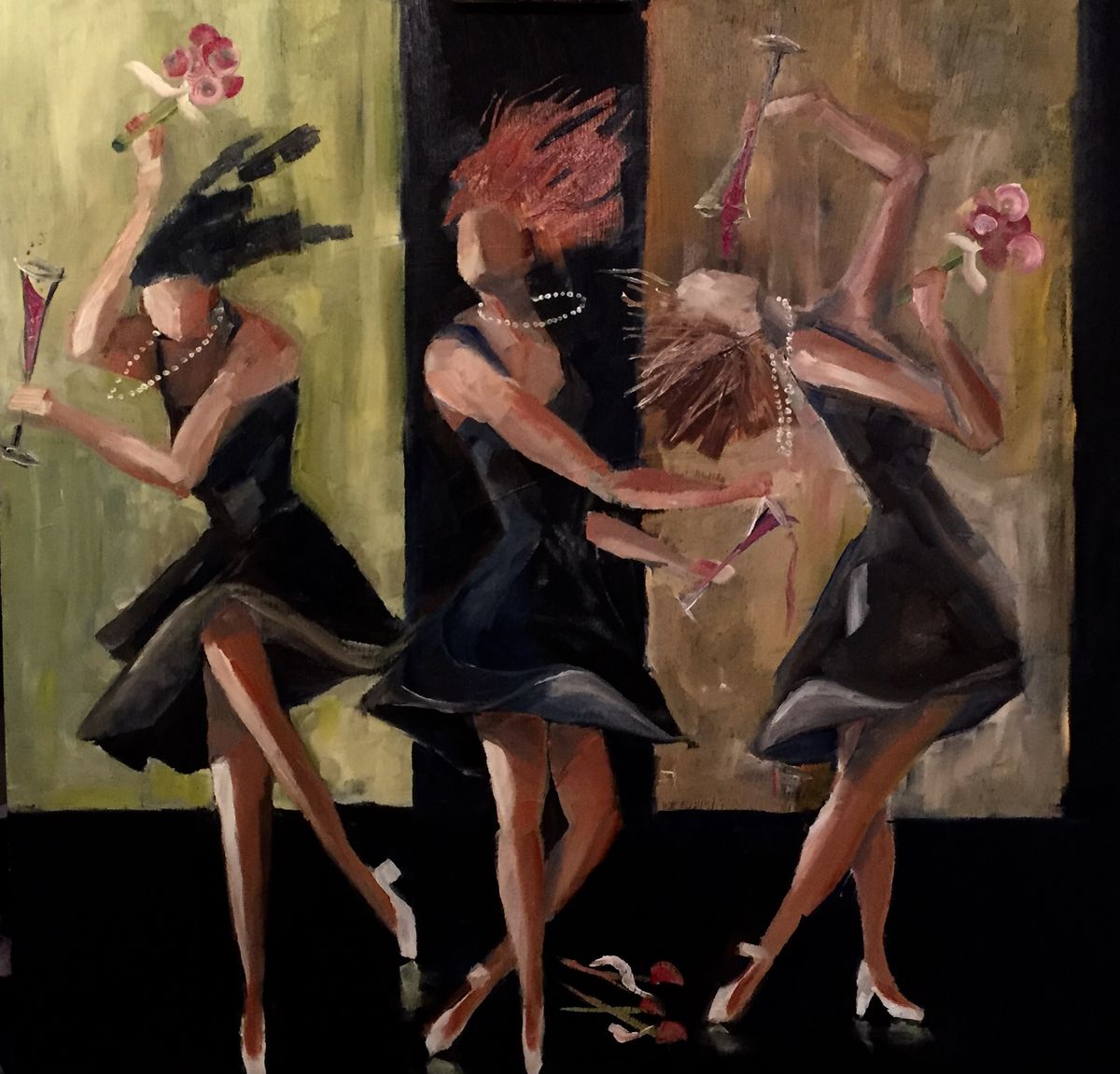
The distinct formlessness of jazz pushes the boundaries of typical music genres and retains a kind of creative freedom through improvisation, rhythm, and the cohesive element between players. Duke Ellington characterizes rhythm as a fundamental element in nature that provides structure and order to everything in our lives, not just music. In what sense is this true? If jazz truly is formless, why does rhythm play such an essential role in its construction?
In Ellington’s first published article (The Duke Steps Out, 1931), he maintains that “our very lives are dependent on rhythm…for everything we do is governed by ordered rhythmic sequences.” While we may be inclined to think of rhythm as providing structure and order within a musical score, Ellington urges us to think of it more broadly as a universal constant of repetition and flux.
In his eyes, rhythm is a fundamental aspect of human experience, and it is present in many different aspects of our lives. We can find many examples of rhythm governing nature, as seen in the regular cycles of the tides and the seasons, the moon’s gravitational pull that causes the ocean to rise and fall, the earth’s orbit around the sun that influences the weather and temperature, the rhythmic breathing of animals as they inhale and exhale, and even the rhythmic chirping of a cricket or the singing of a bird. In this way, Ellington introduces a new meaning of rhythm that connects music with nature and humanity. Music and philosophy often find themselves intertwined.
“When we dance it is not a mere diversion or social accomplishment. It expresses our personality, and right down in us, our souls react to the elemental but eternal rhythm, and the dance is timeless and unhampered by any lineal form.”
Ellington further speaks to the innate fusion of music and soul, one that allows for a free-flowing and creative outlet of expression. Rhythm takes on a dual definition, being both eternal and fluid, yet methodical and continuous in nature. Ellington’s use of “our” tells us that when he visualizes the rhythmic nature of song and dance, he thinks of a community.
In Ellington Defends His Music (1933), he characterizes music as “an expression of a people’s soul”, which speaks volumes when considering the wide-scale efforts of African-Americans to create firm cultural roots in a white-dominated society. Jazz music is more than an “American-idiom”— it signifies the relentless attempts of a people in the face of tyranny and their determination to plant themselves firmly within American culture and society. “What we know as ‘jazz’ is more than just dance music”, Ellington affirms. He elevates jazz music beyond a fixed category, tying it to the natural, fundamental, creative expression of a group of people.
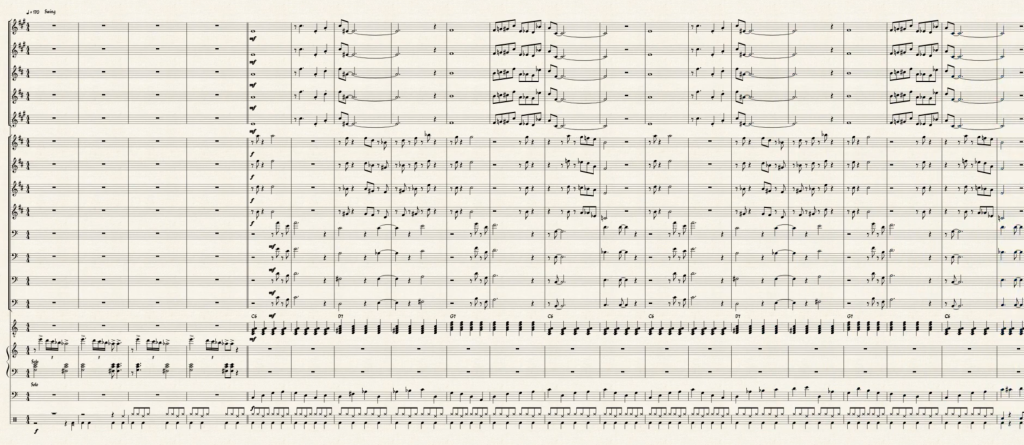
Take the A-Train, Duke Ellington (1939)