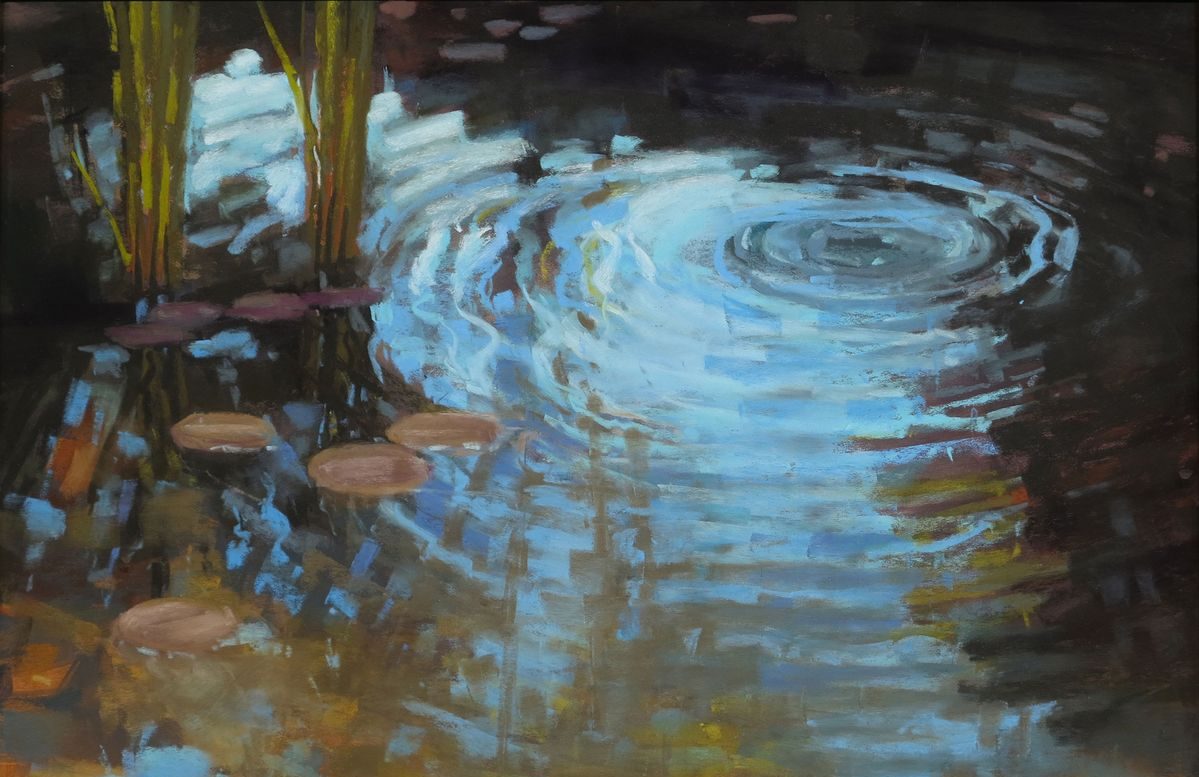
“Are you alive?
I touch you.
You quiver like a sea-fish.
I cover you with my net.
What are you—banded one?”
Hilda Doolittle, Poetry Foundation
This scene is fleeting, yet leaves a lasting impression. Imagist poet H.D. creates a striking, yet vague depiction of self-reflection and vulnerability. The speaker sees something “alive” in the pool, perhaps a nod to the myth of Narcissus. However, rather than exemplify the vanity and self-absorption that would accompany such a trope, the speaker appears to possess more of an innocent curiosity and fascination.
The thing in the pool “quivers” after the speaker touches it, indicating that this may be the speaker’s reflection. The term is packed with a sense of vulnerability and provokes a sense of fleetingness. This is supported by the speaker’s immediate urge to cover the quivering thing with a net. Is covering it an act of protection or entrapment and restriction? Since the following question—”What are you?”—further reinforces the speaker’s curiosity, the act of covering is more likely an attempt to preserve this thing in order to keep observing it. By removing their ability to touch it, the speaker attempts to remove what makes this thing seem “alive.”
If this thing is indeed the speaker’s reflection, this further indicates an attempt at self-preservation and a desire to study and understand oneself without being hindered by such quivering. However, as the human mind and soul is always in a state of flux and will continue to develop and grow, the attempt at covering their reflection seems futile. The real challenge is observing one’s reflection even as it ripples. Narcissus, in his sedentary state of self-admiration, serves as a cautionary example of this. Now that the thing is “banded,” it does not feel as if the speaker will make any real progress.
While the speaker emphasizes the use of “you” throughout the poem, it does not seem as if the thing and the speaker are separate entities. H.D.’s imagery represents a very raw, very human attempt to pause the ephemerality of life in order to study and observe it. “The Pool” encourages the reader to embrace constant change and flux in our journeys of self-reflection, rather than combat it.